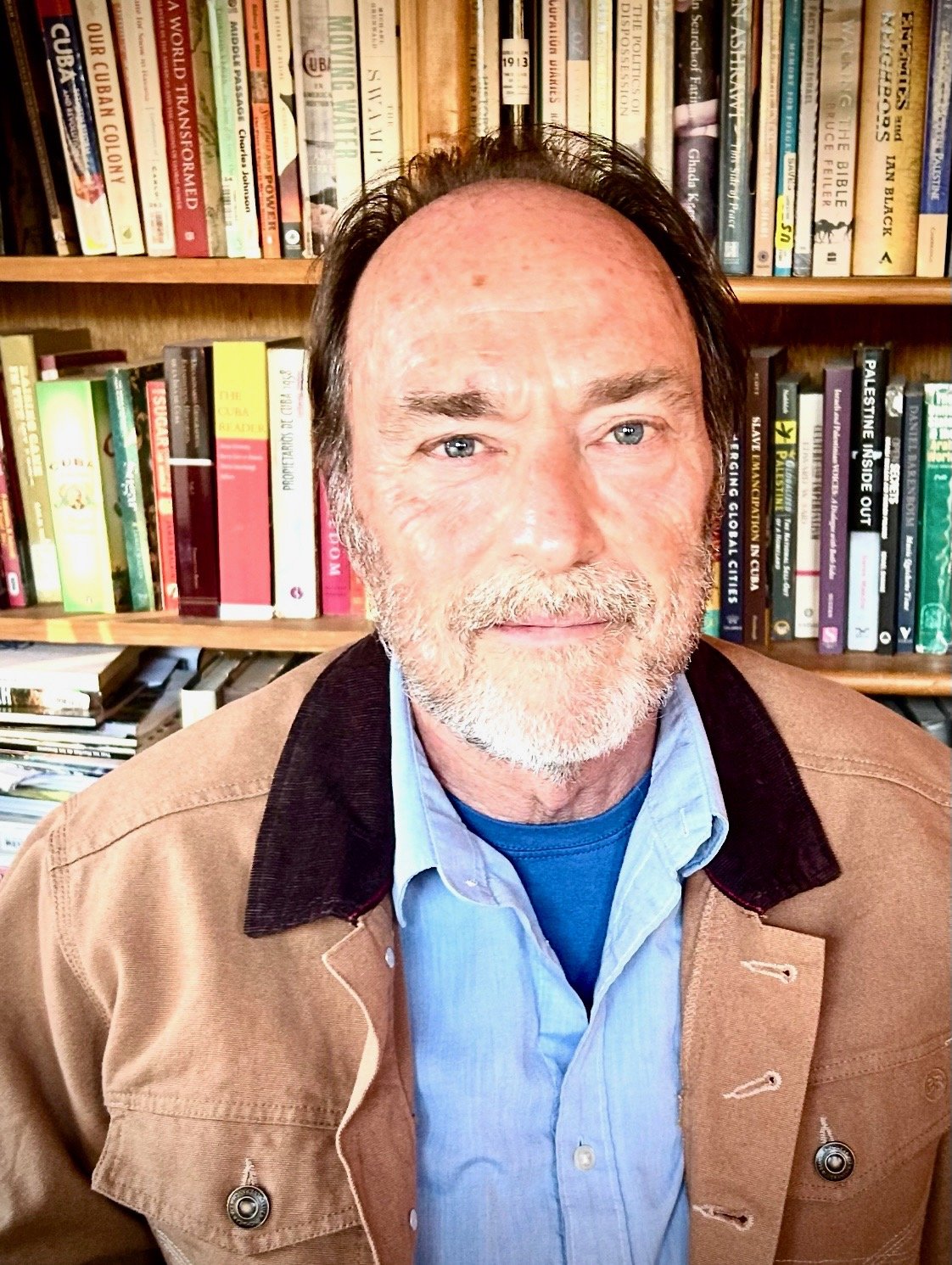
About Sandy

Sandy Tolan Video StillSandy Tolan is a journalist, teacher, and documentary radio producer. He has reported in more than 30 countries, especially in the Middle East, Latin America, the Balkans and Eastern Europe. He has produced dozens of documentaries for National Public Radio and Public Radio International, and has written for more than 40 newspapers and magazines, including the New York Times, the Los Angeles Times, the Christian Science Monitor, USA Today, and The Nation. Much of his focus has been on land, water, natural resources, ethnic conflict and indigenous affairs. He has received more than 25 national and international honors, including two from the Overseas Press Club, the DuPont-Columbia Silver Baton, three Robert F. Kennedy awards for reporting on the disadvantaged, a Harry Chapin World Hunger Year award, and a United Nations Gold Medal award. He was a 1993 Nieman Fellow at Harvard University and an I.F. Stone Fellow at the Graduate School of Journalism at the University of California at Berkeley, where he he teaching international reporting. In 2007 his students won the prestigious George Polk Award for their public radio series on the early signs of climate change – the first time students have received a Polk Award.

Sandy is the author of The Lemon Tree: An Arab, A Jew, and the Heart of the Middle East (Bloomsbury, 2006), based on his award-winning documentary for NPR’s Fresh Air about a Palestinian man, an Israeli woman, and their common bond: a stone home in the town of Ramla, between Jerusalem and Tel Aviv. The book was Booklist’s “Editor’s Choice” for best adult non-fiction book of the year. It was a finalist for the National Book Critics Circle Award, and received the 2006 Christopher Award. His first book, Me and Hank (Free Press, 2000), which the New York Times called “a solid hit,” is an exploration of heroes and race relations in America through the experience of baseball slugger Hank Aaron.

Work in the Field

In 1982, a year after graduating with a degree in film and broadcast journalism from New York University, I left the East to travel back to northern Arizona, where I had attended three years of college. I was drawn by a story, largely unnoticed outside the region, taking place on the vast Navajo reservation. It was about the plight of former uranium miners — old Navajo men, who had worked in the unventilated “doghole” mines digging up ore for the U.S. nuclear weapons program, and who were now dying of cancer and silicosis.

I criss-crossed the reservation, driving down rutted dirt tracks in a friend’s beat-up old Datsun. I learned how to dodge cattle on a darkened roadway; how to appreciate mutton stew and blue cornmeal mush; how one should never leave a tape recorder on the top of one’s car. More important, as I sat in mud hogans talking to old miners with hacking coughs, I learned that I had found my calling: getting the story from the source, on the ground.

The journey to Navajo country was motivated by two fundamental convictions, honed during the post-Watergate years when I attended journalism school. One was that a journalist’s central role ought to be that of a watchdog, driven by the people’s right to know. Another was that fair, compelling, and clearly-told stories could help shape a better society.

A year after I landed back in Arizona, I opened a little news bureau in a room off the lobby of the Monte Vista Hotel in Flagstaff. From there, with other journalist colleagues, under the flag of “Desert West News,” I began covering issues central to life and livelihood in the Southwest: water, coal, power, Indian affairs, Arizona’s far right “survivalists,” immigration, and international trade. I learned Spanish and began traveling to the border, where American church workers had begun smuggling Central American refugees in the nascent “sanctuary movement.” I spent months in and out of shanty towns just south of the Mexican border, and in the U.S. maquiladora manufacturing plants that drew the workers north, for a series of stories on the transformation of the American borderlands. I covered these and other stories for NPR, The Christian Science Monitor, The New York Times Magazine, and dozens of newspapers across the United States.

From the border I went south, traveling in 1990-92 with three other radio journalists to 14 countries in Latin America and the Caribbean for an NPR series called “Vanishing Homelands” – seven hours of documentary reports examining change to landscape and identity across the Americas. In the process, Desert West News became Homelands Productions, and, in subsequent series for NPR (including “Searching for Solutions,” on population growth and sustainable energy, and “World Views,” a series of first-person documentaries), our international coverage continued to grow – to the Balkans, South Asia, and the Middle East. By 1998, I was in the Middle East frequently, and had begun a radio project known as The Lemon Tree, which would later lead to a book of the same name. Along the way my work was honored with more than 25 regional, national and international awards, including a 1986 duPont-Columbia “Silver Baton” (for the coverage of the Sanctuary movement) three Robert F. Kennedy awards (for the maquiladora story, “Vanishing Homelands,” and a report on the Arab view of the West after 9/11), the Lowell Thomas Award from the Overseas Press Club, and a United Nations Gold Medal Award (both for the “Lemon Tree” radio program). In 2003, Homelands began a new public radio series, “Worlds of Difference: Local Culture in a Global Age,” expanding coverage into Africa and east Asia.

Alongside all the radio work, I continued to write for magazines and newspapers, and, in 2000, published my first book, Me and Hank: A Boy and His Hero, Twenty-Five Years Later, an exploration of race and sports through the experience of my boyhood hero, Hank Aaron. The book, which won critical acclaim (The New York Times called it “a solid hit”), opened a new path for me, eventually leading to The Lemon Tree: An Arab, A Jew, and the Heart of the Middle East (Bloomsbury, 2006), which has received excellent reviews and numerous honors, including Booklist’s “Top of the List” for adult nonfiction, and as a finalist for a National Book Critics Circle Award in nonfiction.

Teaching

My passion for teaching was first fueled early in my career, when I began giving the occasional guest lecture about radio, environmental reporting, or telling the story in Indian country or along the U.S.-Mexico border. I spoke in classrooms at NYU, Harvard, Columbia, Tufts, the University of Arizona, and at an Indigenous Broadcast Center workshop in Denver. It was not until the fall of 2000, however, that I taught in a formal classroom setting. That’s when I was a Hewlett Fellow in environmental reporting at the Graduate School of Journalism at Berkeley. Though this was a longer, more structured setting than I’d been accustomed to, I found that it was still possible to bring my own work directly into the classroom – as something practical and useful, not simply as “war stories” to pass on to the next generation. Indeed, through this class, I understood how a powerful mentoring collaboration can break down the walls between the academy and the profession “out there.” The class, in which nine reporters traveled in teams all along the U.S.-Mexico border, resulted in series of student-written articles in the San Jose Mercury News: we took up the Merc’s entire Sunday “World” section in early December 2000. Later work from the class appeared in TV documentary form, and for the NPR series, Latino USA, and the weekly High Country News. The Mercury-News series was then translated into Spanish, where it ran in the Los Angeles-based La Opinion, the largest Spanish-language newspaper in the United States. At the time, we didn’t know the term “convergence,” but that’s essentially what our effort was.

My subsequent classes – on the politics of oil in Latin America; on political tensions and opportunities in Eastern Europe; on the poverty and bounty of the California orange harvest; and on the early signs of climate change – have sent reporters from Berkeley across California and the world. In each of these classes, I have taken a dual classroom/newsroom approach, combining in-depth study seminars about a particular issue with workshops in international reporting, radio feature and documentary production, and finally intensive editing sessions that sometimes go to five or six drafts. The result, across multiple platforms, has been outstanding work written and produced by students for NPR, KQED, Salon.com, Living on Earth, American Radio Works, The Christian Science Monitor and other outlets. Though these classes were not designed at the outset as multimedia courses, that’s what they became: as with the border class, they were examples of classroom convergence. One such class – “Early Signs: Reports from a Warming Planet” – won the 2006 George Polk Award in radio reporting.

For the students, however, and for me, these collaborations have not been about “clips” or awards. Rather they have been about learning how to take up the tools of journalism in a professional, mentored environment where skills sharpen, confidence grows, and students understand first-hand the kind of contributions they can make with their work. The elements of all of these classes – reading, preparation, pre-reporting, skills workshops – have been in the service of getting students ready to get on the ground, whether it’s in Fresno or on the slopes of Mt. Kilimanjaro.

Through these classes, I have found that my passion for teaching is satisfying in a different, deeper way than one feels with the rush of a piece on the front page or getting a big story on the air. It’s the satisfaction of watching people put to work what you’ve helped lead them to. I find this humbling, and moving, in part because it is part of an ancient process: the transfer of knowledge.

At Berkeley, I’ve helped run the international reporting program, and toward that end have invited visiting lecturers from Egypt and Israel; facilitated public discussions with a range of writers and scholars on topics ranging from Latin America to the Middle East to North Korea; and organized a series of conferences, including a 2004 forum on press coverage of the buildup and aftermath of the U.S. invasion of Iraq, and three annual conferences, designed for young journalists, on the nuts and bolts of international reporting. And for the PBS series, Frontline World, which is affiliated with the Journalism School at Berkeley, I have been advisor for student fellowships, which result in multimedia projects, Web-based “Rough Cuts” ,  or occasionally as broadcast pieces on PBS .